

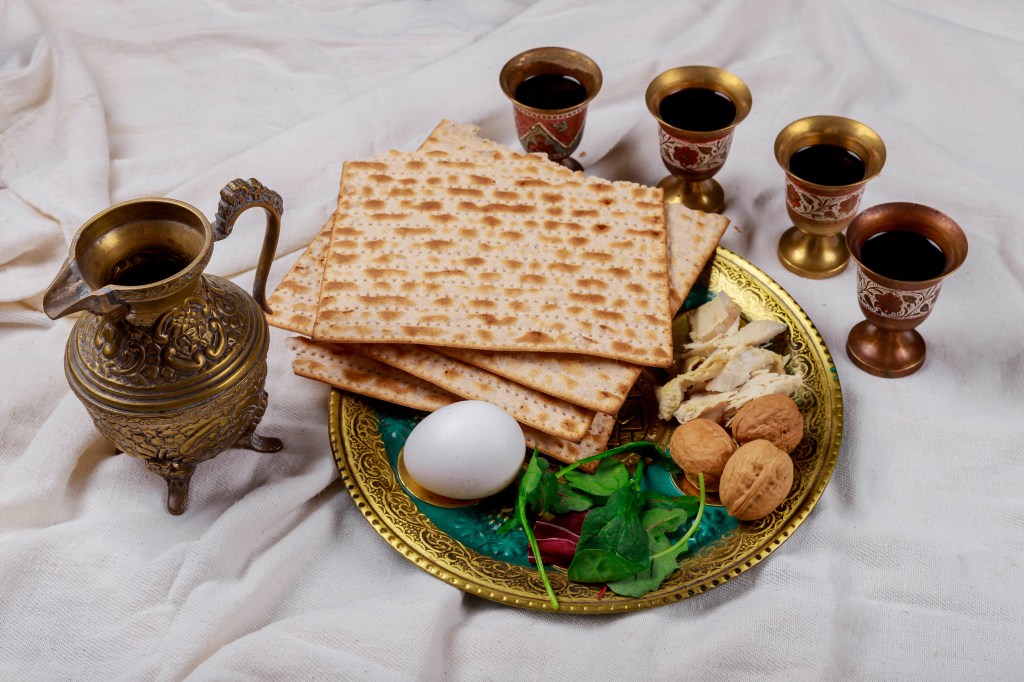
Today, almost unanimously, Jews keep the Passover in the same manner. On the 14th day of the first month, Abib, a Seder meal of roasted lamb seasoned with bitter herbs, and wine is prepared. Then after sunset (which begins the next day) they come together with friends and family and eat that meal served with four cups of wine that mark stages of the meal. After the meal comes the the Haggadah—a retelling of the Exodus from bondage where the children of Israel left Egypt by night with a high hand from God.
During the 7 days of the Passover week, many eat only unleavened bread, the bread of affliction, having removed all leavening from their homes. This seven day period commemorates the 7 days it took the Children of Israel to travel from Egypt and cross the Red Sea.
However, there are some big problems with this tradition. First of all, Leviticus 23 and Exodus 12 clearly show that there are two festivals during this period: Passover and the Feast of Unleavened Bread. Second, from Exodus 21:18&19 we learn that this is an 8 day festival: one day for Passover and seven days for the Feast of Unleavened Bread (v17). Third, there is two distinct meanings that are to be remembered for these festivals: Passover commemorates YHWH passing over judgement- forgiving the Israelites(v13-14), where as the Festival of Unleavened Bread pictures bringing the Hebrews out of Egypt (v17).
Although originally these were two festivals, at some time around the Babylonian exile, the Jews began referring to the entire spring holy-day season as Passover. The term “Passover” became a broad term referring to either festival. Luke explains this in chapter 22:
Now the feast of unleavened bread drew near, which is called the Passover.
Luke 22:1 KJ2000
And because of the confusion many started blending the 2 festivals into one as Josephus clearly notes:
“And indeed, at the feast of unleavened bread, which was now at hand, and is called by the Jews the Passover…” (War of the Jews, Bk. II, Ch. I, Sec. 3).
However, there were many Jews in the first century, like Mark, who understood that this spring holyday season was made up of two festivals, not one:
After two days was the feast of the passover, and of unleavened bread: and the chief priests and the scribes sought how they might take him by craft, and put him to death.
Mark 14:1 KJV2000
Now although there were some Jewish sects (like the Pharisees) at the time of Christ who had combined Passover with the Feast of Unleavened Bread, there were many Jews who did not. Josephus, who lived in the first century AD clearly notes that the Feast of Passover had a separate meaning and was kept on a separate day, from the Feast of Unleavened Bread.
“…But when the fourteenth day was come,(at the beginning of the 14th NOT the end) and all were ready to depart[Egypt], they offered the sacrifice, and purified their houses with the blood, using a bunch of hyssop for that purpose; and when they had supped, they burnt the remainder of the flesh, as just ready to depart. Whence it is that we do still offer this sacrifice in like manner to this day, and call this festival Pascha, which signifies the feast of the passover, because on that day God passed us over, and sent the plague upon the Egyptians; for the destruction of the first-born came upon the Egyptians that night…” (Antiquities of the Jews, Bk. 11, Ch. XIV, Sec. 6)
Josephus echos what Exodus 12:12-13&27 states: that Passover is a separate feast that pictures the judgment of God passing over the Israelites but being brought upon the land of Egypt, killing the first born. Josephus then goes on to talk about the Feast of Unleavened Bread:
“Now, upon the approach of that Feast of Unleavened Bread, which the law of their fathers had appointed for the Jews at this time, which feast is called Passover, and is a memorial of their deliverance out of Egypt…” (Ibid., Bk. XVII, Ch. IX,Sec. 3).
Notice he states that it is called Passover– not that it is Passover. He then confirms the Feast of Unleavened Bread memorializes deliverance out of Egypt. This matches Exodus 12:17 exactly:
“you shall observe the Feast of Unleavened Bread, for on this very day I brought your hosts out of the land of Egypt.” Exodus 12:17
And once again Josephus, like Mark and Luke, indicate that the Jews of the day used the term Passover to refer to the Festival of Unleavened Bread.
Another mistaken belief is that Passover lambs were always sacrificed by the Priests. Although once again, Pharisaical Jews had the priests sacrifice the lambs for them during the afternoon of the 14th, but many Jews did not. The Jewish historian Philo records this:
“...the day called by the Hebrews in their own tongue, the Pasch [Passover], on the which the whole people sacrifice, every member of them, WITHOUT WAITING FOR THE PRIESTS, because the law has granted to the whole nation for one special day in every year the right of priesthood and of performing the sacrifice themselves” (Philo, De Decalogue, p. 159,)
And this is exactly the pattern we see in all four Gospel accounts, where Yeshuah Messiah and his disciples kept a private domestic Passover a day before the Pharisees did. And Paul confirms that is the same day we ought to keep the Passover.
For I received from the Lord that which I also delivered to you: that the Lord Jesus on the same night in which He was betrayed took bread;and when He had given thanks, He broke it and said, “Take, eat; this is My body which is broken for you; do this in remembrance of Me.”
1 Corinthians 11:23-24 NKJV
We have no indication from scripture that Yeshuah Messiah kept the Passover on the wrong day.
And this practice of the New Testament church observing Passover a day before the Feast of Unleavened Bread matches perfectly with the account in the Torah. This is described very clearly in the book of Numbers where we see the children of Israel left Egypt on the day after the Passover – which would be the Feast of Unleavened bread.
They departed from Rameses in the first month, on the fifteenth day of the first month; on the day after the Passover the children of Israel went out with boldness in the sight of all the Egyptians.
Numbers 33:3
If YHWH passed over the Israelites and struck the Egyptians at night(Exodus 12:12,29), the children of Israel left Egypt by night(v42), and according to Number 33, these events took place a day apart, it doesn’t take a mathematician to realize these events took place on two separate days.
So if the scriptural and historical records are so clear, why do Jews today keep the Passover on the night beginning the first day of Feast of Unleavened Bread? Much of this comes from Deuteronomy 16:
there you shall sacrifice the Passover at twilight, at the going down of the sun, at the time you came out of Egypt.
Deuteronomy 16:6
As was mentioned earlier, at some point in time, the term “Passover” was being used to refer to the entire Spring Holy Day season- which has caused some confusion. Also as has been noted, editorial updates have been made by the Prophets through out scripture for clarity. As we will see, at some point in time, Deuteronomy 16 was updated by a prophet (most likely Ezra) using the broad term “Passover” referring to the entire spring holy day season, which would include the Feast of Unleavened Bread. And there are numerous references in chapter 16 that supports this.
From first glance it seems as though Numbers 33 and Deuteronomy 16 contradict one another. Numbers states that they left on the day after the Passover, where Deuteronomy states you are to perform the Passover sacrifice during the time you left Egypt (the 15th of Abib). What is going on? Notice verse 2:
Therefore you shall sacrifice the Passover to the LORD your God, from the flock and the herd
Deuteronomy 16:2
At face value, if this was referring to the Passover Festival (not the Spring holyday season), you could have a Passover cow! This is in direct conflict with Exodus 12:5 that states: “You may take it from the sheep or from the goats.” The Hebrew word in Deut 16:2 herd (bâqâr) refers only to bovine. Another conflict is found in verse 7:
And you shall boil (bahel) and eat it in the place which the LORD your God shall choose.
Deuteronomy 16:7 AFV
Although some translations say “roast” here in place of boil, the Hebrew word is bashel (בָּשֵׁל). Exodus 12:9 states clearly the Passover sacrifice was not to be boiled (bashel). “Eat not of it raw, nor bashel (בָּשֵׁל)”. Another direct conflict. Several more conflicts are found in verse 3:
Thou shalt eat no leavened bread with it; seven days shalt thou eat unleavened bread therewith, even the bread of affliction; for thou camest forth out of the land of Egypt in haste
Deuteronomy 16:3 KJV
There are numerous conflicts here with the book of Exodus. First, Passover commemorates YHWH passing over the Israelites but upon the Egyptians. The Festival of Unleavened Bread pictures coming out of Egypt. Second there is no specific command to eat unleavened bread on Passover. Third, Passover is a one day festival- not a seven day festival. Fourth, the bread of affliction is only associated with the Feast of Unleavened Bread, not Passover. Obviously the broad term for Passover as the Spring holy-day season is being used here.
And when we come to Deuteronomy 16:4 the message is abundantly clear that this section of scripture is referring to the Feast of Unleavened Bread. “And no leaven shall be seen among you in all your territory for seven days, nor nor shall any of the meat which you sacrifice the first day“. This is directly referring to the Feast of Unleavened Bread NOT Passover. There isn’t a first day of Passover because there is only ONE day for Passover. This is clearly talking about the Feast of Unleavened Bread.
As many of us know “Deuteronomy” means “second law” in Greek because Moses, in the book repeats many of the statutes given in the previous four books but in a more concise manner. For instance, Deuteronomy 5 is a parallel passage to Exodus 20- both list the 10 commandments. The parallel passage for Deuteronomy 16 is Numbers 28. Both chapters list all of the sacrifices that the Priests are responsible for.
The first thing we notice from Numbers 28 is that their are no instructions for the Passover lamb sacrifice. That is because it was not to be done by the priests- it was to be done domestically by each household as was mentioned earlier.
Second, we see as before, Passover and Unleavened Bread is listed as two separate feasts on two separate days as indicated in verse 16&17.
Third when we look at the offerings given on the Feast of Unleavened Bread in verses 18&19, it matches Deuteronomy 16 in that on the first day there were sacrifices given from the flock and the herd- sheep and cattle.
It is clear that Deuteronomy 16:1-8 and Numbers 28:16-25 are parallel passages both focusing on the sacrifices by the priests during the Feast of Unleavened Bread NOT the Passover lamb sacrifice.
But one of the most important instruction given about all the offerings in Numbers chapter 28 is in verse 2:
Command the children of Israel, and say to them, ‘My offering, My food for My offerings made by fire as a sweet aroma to Me, you shall be careful to offer to Me at their appointed time.
Numbers 28:2 NKJV
Why would they need to be so careful to offer the sacrifices “at their appointed time“? Why is the timing so of the Festivals so important?
Consider this: if you were to prepare a birthday dinner for your wife, you try to honor her preferences— her favorite foods, drinks, and desserts. You would also make sure to celebrate it on the right day. But if you instead threw the party on the wrong day, with the wrong food, and in the wrong manner, she might not hand you divorce papers immediately, but she would rightly feel disrespected. In the same manner, God is honored when His people remember Him and keep His Holydays in the way He instructed at the time He instructed. Scripture says, ‘Them that honor Me I will honor, and they that despise Me shall be lightly esteemed’ (1 Samuel 2:30). God has respect and favor toward those who show respect for Him by obeying His word as He delivered it.
Understanding the correct way and correct timing of when to keep the Passover and Feast of Unleavened bread isn’t a pursuit of Bible trivia, it is a sign of showing respect to God. And when we go against the grain of human tradition- when we step out in faith to keep the Passover as it is commanded in scripture- we demonstrate that our loyalty is to God rather than to men, trusting that He honors those who honor Him.
 My Hebrew Roots