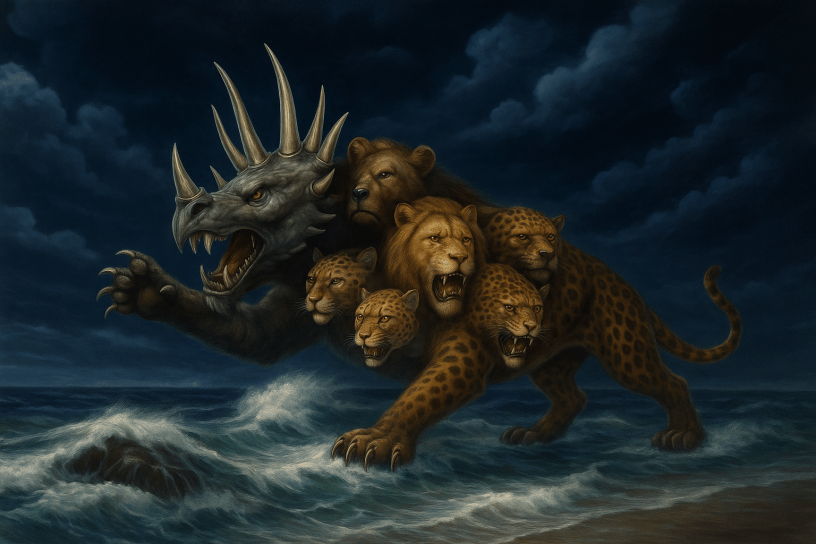
Second only to the Devil himself, The Beast of Revelation is not only one of the most prominent characters of the book, but also the most sinister. The capstone volume of the Bible written by the Apostle John – the Book of Revelation- not only describes the Beast as the spokesman for Satan but is responsible for much of the death and destruction during the Great Tribulation. The book of Revelation describes how the Beast:
- Works with the power and authority of Satan (Rev 13:2)
- Kills the two witnesses (Rev 11:7)
- Kills anyone who doesn’t worship the False Prophet (Rev 13:15)
- Attacks and kills many of the saints (Rev 13:7)
- Forces everyone to accept his mark or they will not be able to buy or sell.(Rev 13:17)
- Causes the World to worship the Dragon and himself.(Rev 13:4)
In addition there are grave warnings given by the Apostle John to anyone who is deceived by the beast, receives his image and worships him and his religious system.
“If any man worship the beast and his image, and receive his mark in his forehead, or in his hand, the same shall drink of the wine of the wrath of God, which is poured out without mixture” (Rev. 14:9, 10).
The key to understanding who the beast is in the vision of John in Revelation 13:
“I saw a beast rise up out of the sea, having seven heads and ten horns, and upon his horns ten crowns, and upon his heads the name of blasphemy. And the beast which I saw was like unto a leopard, and his feet were as the feet of a bear, and his mouth as the mouth of a lion: and the dragon gave him his power, and his seat, and great authority” (Rev. 13:1-2).
As we try to envision this hideous beast with seven heads of different animals, we need to realize that all of this is highly symbolic. Each of these descriptors is a clue helping us identify who this Beast is. And the Book of Daniel is the key to deciphering these clues.
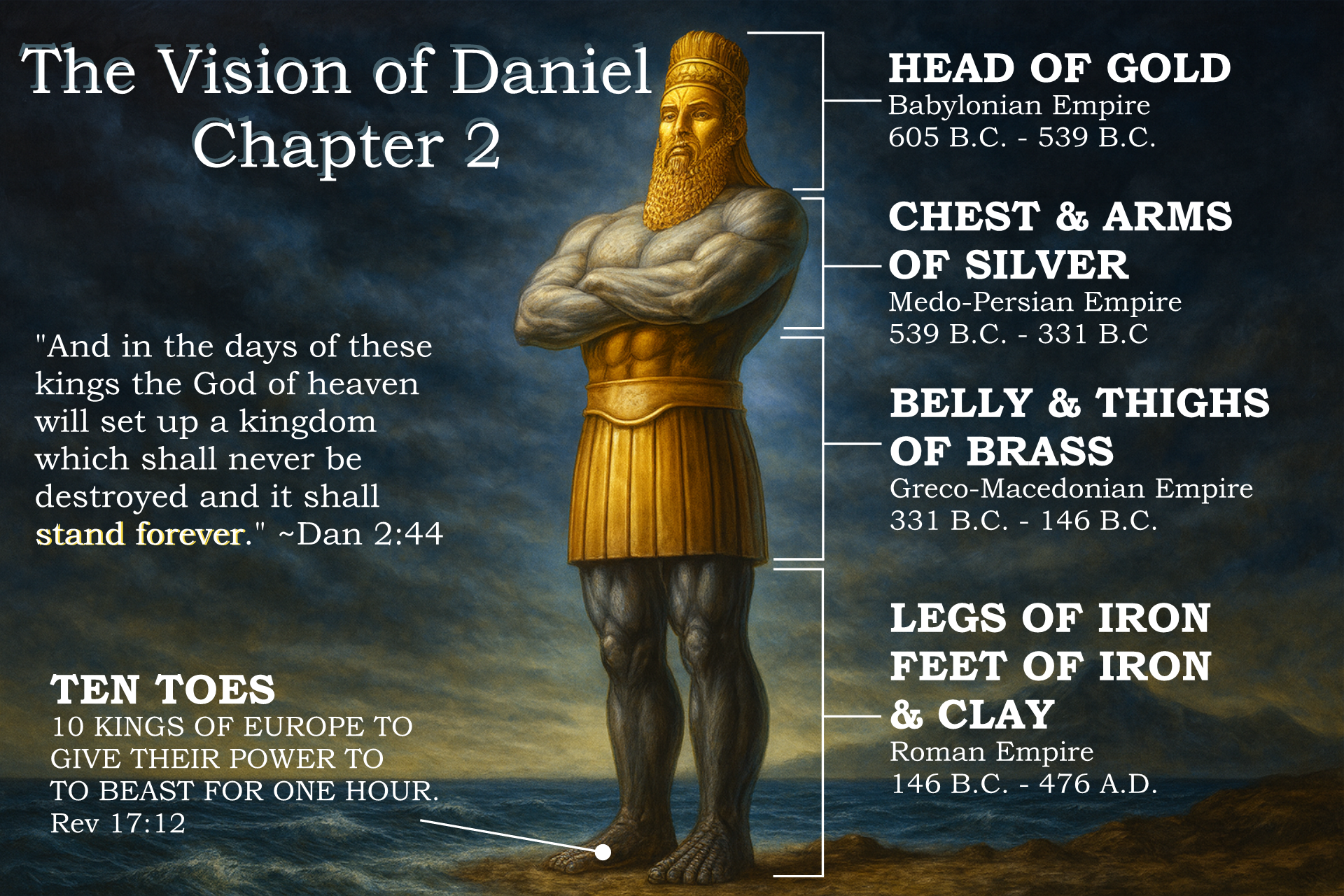
One of the clearest and best outlines in all of bible prophecy is the image of Nebuchadnezzar in Daniel chapter two. This vision is a straight forward description of world events from the time of Daniel to the time of the end. In Daniel chapter 2 verse 32 we learn of a statue that:
“[Its] head was of fine gold, its chest and arms of silver, its belly and thighs of bronze,its legs of iron, its feet partly of iron and partly of clay. You watched while a stone was cut out without hands, which struck the image on its feet of iron and clay, and broke them in pieces.” (Dan 2:32-34)
Daniel quickly gives the interpretation to Nebuchadnezzar:
You are [Your kingdom is] this head of gold. But after you shall arise another kingdom inferior to yours; then another, a third kingdom of bronze, which shall rule over all the earth. And the fourth kingdom shall be as strong as iron, inasmuch as iron breaks in pieces and shatters everything; and like iron that crushes, that kingdom will break in pieces and crush all the others…the toes of the feet were partly of iron and partly of clay, so the kingdom shall be partly strong and partly fragile. And in the days of these kings the God of heaven will set up a kingdom which shall never be destroyed; and the kingdom shall not be left to other people; it shall break in pieces and consume all these kingdoms, and it shall stand forever. (Dan 2:37-44)
Nebuchadnezzar’s vision of a statue divided into 4 parts is quickly deciphered by Daniel as being symbolic for 4 empires in succession: The Babyloian, Medo-Persian, Greco-Macedonian and Roman Empires. As straight forward as this vision appears to be, the confusing part is that during the “days of these Kings” God will establish his kingdom, The Kingdom of God. How can that be?
Many of these questions can be answered in the parallel vision of Daniel 7. Here we have the exact same line up as Daniel 2 except using different symbols. In the vision four beasts come out of the sea: One like a Lion, one like a bear, one with four heads of a leopard and one great and terrible beast. Just as before, these four symbols (beasts) are destroyed, and God’s kingdom is established.
An identical interpretation to the vision of Chapter 2 is given in verse 17 where we learn:
These great beasts, which are four, are four kings that shall arise out of the earth. But the saints of the Most High shall receive the kingdom and possess the kingdom forever, even forever and ever.’
(Daniel 7:17-18)
The reason we know that these four kings are also four kingdoms is from verse 22:
The fourth beast shall be the fourth kingdom upon earth, which shall be different from all the other kingdoms and shall devour the whole earth, and shall trample it and break it in pieces. And the ten horns out of this kingdom are ten kings that shall arise. And another shall arise after them. And he shall be different from the first, and he shall subdue three kings. Dan 7:23-24
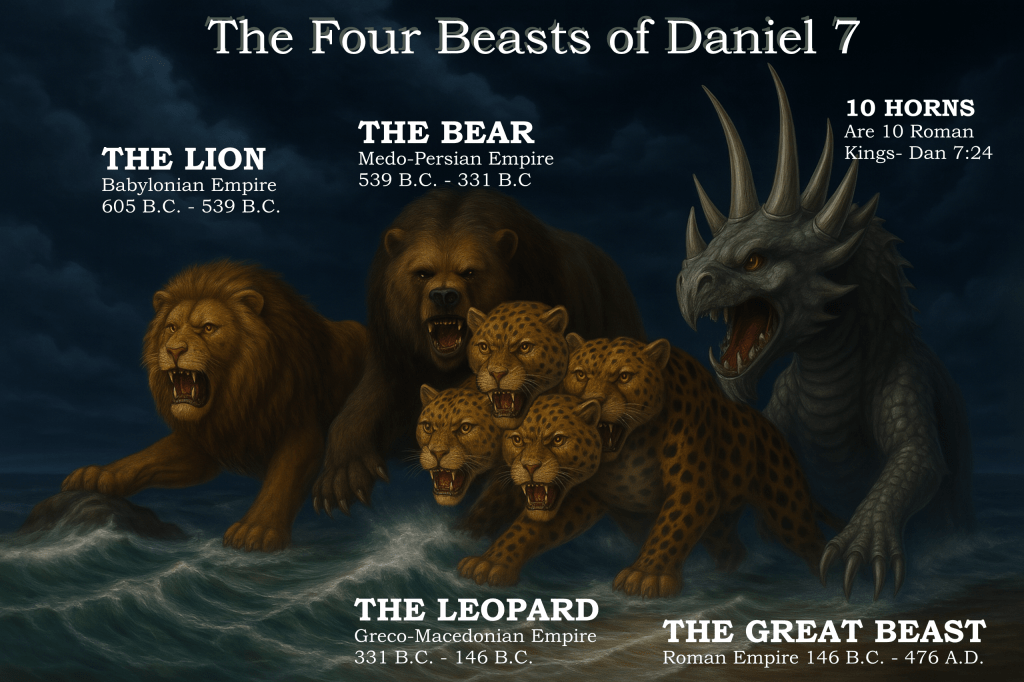
The most important connection to note is that these four beasts combined are identical to the description of the Beast of Revelation 13 made up of a Lion, Bear, Leopard and a fourth Great and Terrible Beast. So instead of having 2 parallel visions we now have 3– with the lion representing the Babylonian Empire. The bear representing the Medo-Persian Empire, the four headed leopard representing the four divisions of the Greco-Macedonian Empire and the Great Beast being the Roman Empire.
And just like the vision of Nebuchadnezzar, these four beast represent four kingdoms that take place in succession and are conquered by the Son of Man (Dan 7:13&14) and replaced by the Kingdom of God. This is none other than Yeshua Messiah, the Lamb of God. This is identical to the fate of the Beast of Revelation:
These [kings of the Beast] will make war with the Lamb, and the Lamb will overcome them, for He is Lord of lords and King of kings; and those who are with Him are called, chosen, and faithful.
(Rev 17:14)
It is difficult to ignore that fact that in all 3 visions they are all being replaced by the Kingdom of God. It is undeniable that these visions are referring to the same situation. These beasts represent 4 empires with the final empire being the Roman Empire. The Beast of Revelation is the Roman Empire.
Now your immediate response is probably: “That can’t be! The Roman Empire collapsed over 1500 years ago.” That is true. But one of the reasons why the last beast is ‘great and terrible” is because it keeps coming back to life. It doesn’t die. This is mentioned in Revelation 17:8
The beast that you saw was, and is not; and shall ascend out of the bottomless pit,
The Roman Empire did exist in the past. It did collapse and cease to be and it did ascend out of destruction. There were actually 6 resurrections or revivals of the Holy Roman Empire with one more to come.
- Justinian (A.D. 554)
- Charlemagne (A.D. 800)
- Otto the Great (A.D. 962)
- Charles V (1519–1556)
- Napoleon (1804–1815)
- Adolf Hitler (1933–1945)
These revivals are predicted in Revelation 17:10 with the 6th revivals being discovered by the Church in 1940.
“The seven heads are seven hills upon which the woman is sitting; And they are also seven kings, five of whom have fallen, one still exists [and is reigning]; the other [the seventh] has not yet appeared..” Rev 17:9-10 AMP
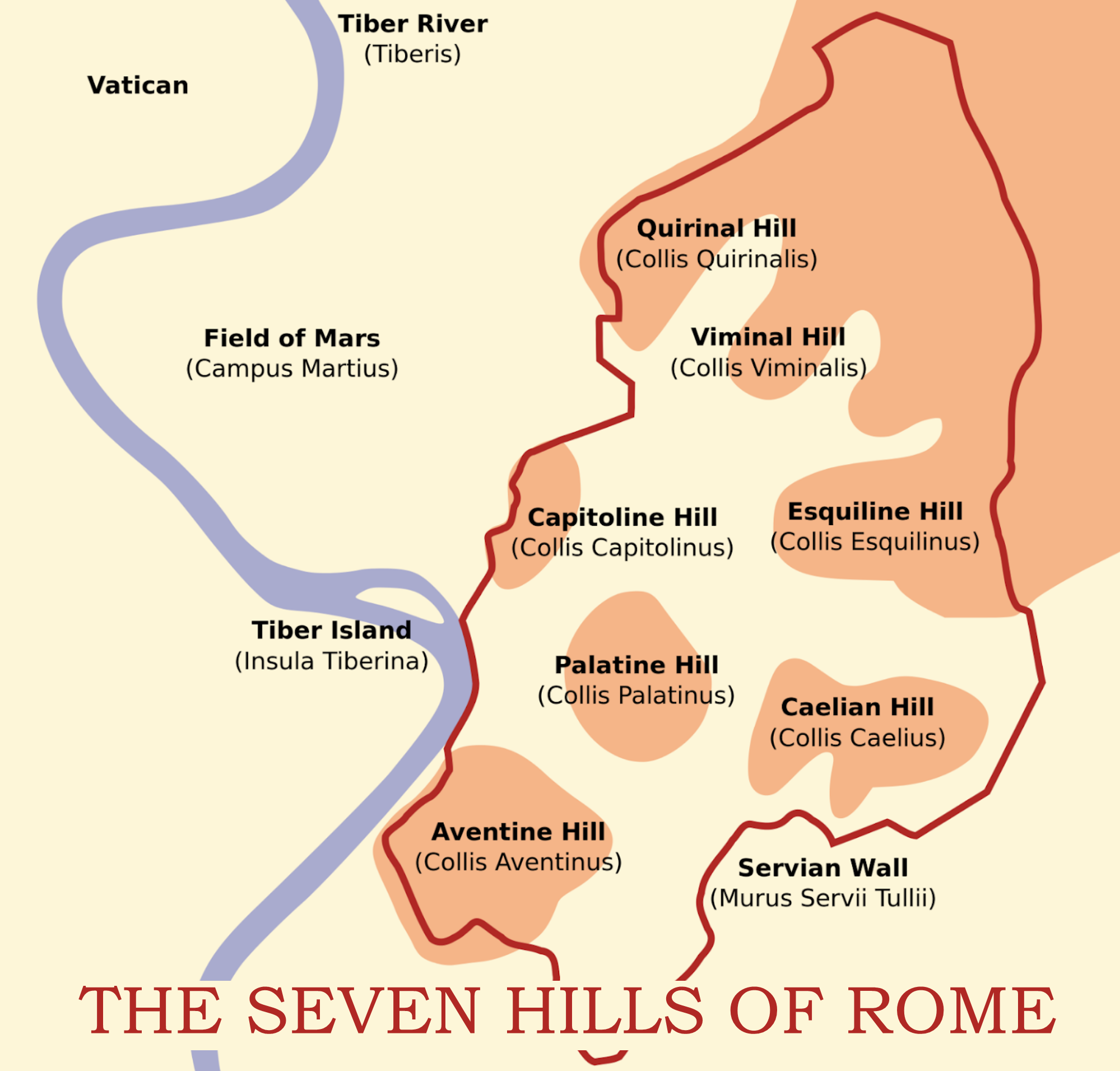
In addition to Rome being known commonly as the “City of Seven Hills” these seven heads also represent seven kings who come and go over the course of time. This explains how “the world will marvel to see the beast, because it was and is not and is to come.”(Rev17:8 ESV) The world will be amazed to see how this Roman system continues to revive itself again and again.
During each of the revivals we see very distinct patterns where the leader either was crowned as Roman Emperor or declared his reign to be a restoration of the Roman Empire. And in each of these revivals this “head” of the empire had a direct alliance to the Roman Catholic Church and the Pope. Remember, the Woman (The Roman Catholic Church) rides the Beast (The Roman Empire) (Rev 17:3). Not surprisingly durring each of these revivals there was a distinct and marked increase in antisemitism and oppression of Jews and Judaizers- Christians who respect the law of Moses and have a faith in Christ (Gibbon). I fit in both categories.
Justinian (554 A.D.) According to Procopius in the Wars of Justinian, and in other ecclesiastical histories, they mark this era as the restoration of imperial dominion in the West. Without delay Justinian recognized the Pope’s ecclesiastical supremacy, officially binding Church and Empire in a new phase- The Holy Roman Empire. Although prior to 500 AD Jews and Judaizers retained significant religious and civic freedoms, this ended with the rule of Justinian. He banned the Mishnah and Hebrew Scriptures to be read in public, prohibited synagogue construction and forced Christian sermons to be delivered in synagogues. In addition to denying Jews the right to hold public office, Antisemitism became Roman Imperial law.
Charlemagne (800 A.D.) On Christmas day in 800 A.D. Pope Leo III crowned Charlemagne as “Emperor of the Romans” in St. Peter’s Basilica. As documented in Einhard’s “Life of Charlemagne”, Charlemagne was deliberately trying to imitate Roman order and law during his rule. Prior to Charlemagne and the Merovingian Frankish Period, Jews enjoyed economic freedom, acting as merchants, landowners, and moneylenders. Several Jewish communities thrived in Narbonne, Spain, and parts of Italy. However incrementally as he allowed more and more Catholic control, Jews and Judaizers saw a persistent increase of oppression. In the Council of Frankfurt in 794, the Catholic Church condemned the adoption of Jewish practices by Christians and reinforced separation.
Otto the Great (962 A.D.) Like Charlemagne, who was his ancestor, Otto was a Frankish (German) king who expanded his territory and was crowned “Holy Roman Emperor” by the pope of his day- John XII in Rome. And just like forefathers, Otto strengthened Roman Catholic canon law and the Inquisition authority, targeting heretics and Judaizers. By the time of Otto’s death, thousands of Jews and Jewish Christians had been massacred, forced to convert and/or had their property seized. Even after his death in 973 A.D. his empire continued the oppression devastating Jewish communities in Mainz, Worms, and Speyer.
Charles the V (1519–1556) Another descendant of Charlemagne, Charles the V revived the Empire in 1527 when he was crowned Holy Roman Emperor by Pope Clement VII. In 1545 Charles entered into an agreement with the Vatican in the Council of Trent which supported and extended existing antisemitic policies of the Vatican such as the 1492 Edict of Expulsion in Spain, forcing Jews to convert or flee. Like other Holy Roman Emperors, Jewish communities that had previously flourished were driven out, sent to ghettos or worse. The Sanchez family went to New Spain.
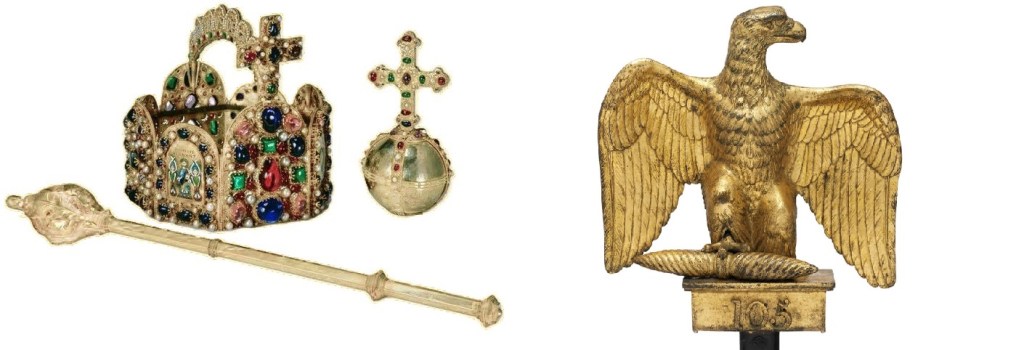
Napoleon Bonaparte (1804–1815) Although from noble family from Cosica, Italy- Napoleon had no documented ancestral line from Charlemagne. Never the less, he consciously and strategically presented himself as the successor and heir to Charlemagne’s legacy. Napoleon was crowned Holy Roman Emperor by Pope Pius the VII. In his regalia he wore the crown, sword and scepter of Charlemagne (Imperial Regalia). He chose the Roman eagle as his standard and mimicked Roman governance and military tactics. Although Napoleon himself did not appear to be antisemitic, his alliance with the Roman Catholic Church empowered antisemitism. Napoleon imposed his “infamous decrees” in 1808 that greatly restricted Jewish economic freedoms and canceled debts owed to Jews. These decrees also included forced / mandated assimilation of Jews into French Society.
Adolf Hitler (1933–1945) Although the atrocities of Adolf Hitler’s antisemitism are well documented, what is rarely understood is his connection to the Holy Roman Empire. The First Reich itself is a reference to the Holy Roman Empire founded by Charlemagne. In 1938, Hitler had the Imperial Regalia of Holy Roman Emperors (The Crown, Orb and Scepter) moved from Vienna to Nuremberg- the Headquarters of the Nazi Party. Then, in a speech after the occupation of Bohemia in 1939, Hitler declared that the Holy Roman Empire had been “resurrected”. Mussolini, the dictator of Italy and who also was an ally of Hitler stated “We have buried the bones of the Roman Empire, and now we will resurrect it” referring to their alliance. Although it had never been widely acknowledged until the book “Hitler’s Pope” by John Cornwell, Pope Pius XII worked with and accommodated antisemitic policies the Axis powers during WWII.
Looking at each of these six revivals of the Roman Empire, it is easy to see these reoccurring patterns. Prior to each revival European Jews had relative prosperity and freedom in an absence of a Emperor. We then see a strong military leader who not only controls a larger percentage of Europe but aligns himself with the Roman Catholic Church. He then either is crowned Holy Roman Emperor or declares himself to be. Then either by his lead or by the Pope, we see a dramatic escalation of persecution upon Jews as well as Jewish Christians.
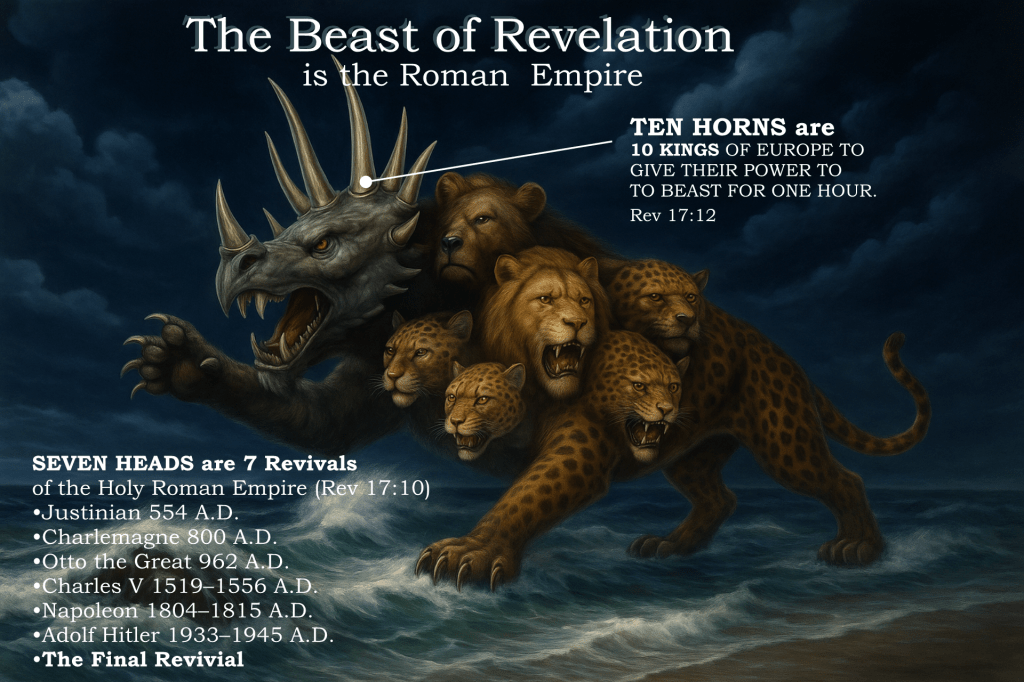
But as Revelation 17:10 states “one [Holy Roman Emperor] is still yet to come.”
Just as the Head of Gold of Daniel 2 represented both King Nebuchadnezzar AND the Babyolnian empire, the Beast represents both the Empire and the Emperor. This final revival of the Roman Empire is represented by the Last Holy Roman Emperor prophesied as the son of perdition (2Thes 2:3), King of the North (Dan 11), little horn (Dan 7:8) and the Beast who undoubtedly will follow all of the patterns of the previous six revivals. We are looking for a strong military leader from Eastern Europe who most likely will be German and a descendant of Charlemagne, and patterns his rule after Past emperors. During his reign he will, as all other Holy Roman Emperors have, work in conjunction with the Pope bringing in an era of increased antisemitism. Sabbath keepers of all types should expect great persecution by the Beast and the False Prophet.
And it was given unto him to make war with the saints, and to overcome them: and power was given him over all tribes, and tongues, and nations. Rev 13:7
During his reign he and his empire will be responsible not only for the persecution of the saints but for the enslavement of the modern nations of Israel (Jer 30 & Ez 39). He will surround and capture Jerusalem (Zech 14:2), take control of the temple, stop the “daily sacrifices and place there the abomination of desolation” (Dan 11:31).
And now we come to understand the 10 horns of Daniel 7 and the 10 toes of Daniel 2. Notice Revelation 17:12:
The ten horns which you saw are ten kings who have received no kingdom as yet, but they receive authority for one hour as kings with the beast. “These are of one mind, and they will give their power and authority to the beast.
Rev 17:12-13 NKJV.
Unlike previous Holy Roman Emperors who received their kingdom through military force, 10 leaders of European nations will give their allegiance to this German leader much in the same way that Mussolini gave over the allegiance of Italy to Adolf Hitler. However, we learn that this union of 10 nations will be a very weak union.
And as the toes of the feet were part of iron, and part of clay, so the kingdom shall be partly strong, and partly broken. And as you saw iron mixed with miry clay, they shall mingle themselves with the descendants of men: but they shall not hold one to another, even as iron is not mixed with clay. Dan 2:42-43.
This confederation of kings will be short lived and will come to an end with the reign of Jesus Christ as King of Kings and Lord of Lords. And the Saints shall reign with him.
And in the days of these kings shall the God of heaven set up a kingdom, which shall never be destroyed. Dan 2:44
And the kingdom and dominion, and the greatness of the kingdom under the whole heaven, shall be given to the people of the saints of the most High, whose kingdom is an everlasting kingdom, and all dominions shall serve and obey Him. Dan 7:27
These shall make war with the Lamb, and the Lamb shall overcome them: for he is Lord of lords, and King of kings: and they that are with him are called, and chosen, and faithful. Rev 17:14
 My Hebrew Roots