
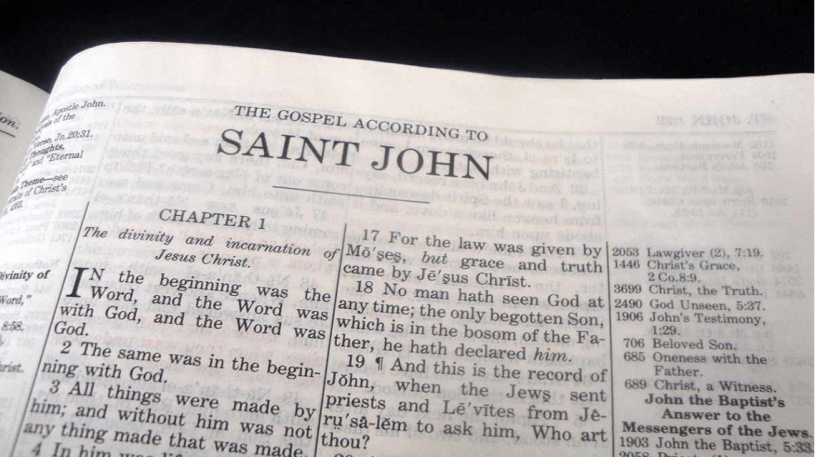
The Gospel According to John has been heralded by many as being the most significant book in the New Testament – and for good reason. From it, we get the most in-depth understanding of the relationship that the Father and the Son had from the beginning. From the last message to the disciples in Chapter 14, 15, and 16, we listen to Christ’s passionate instruction to the Church and His relationship to them. From the prayer of Christ to the Father in chapter 17, we gain unique insight into the pre-existance of Christ and the unity between the Father and Son. Also, the seven “I Am” statements are found in no other place but in the Gospel of John:
- “I am the Bread of Life” (John 6:35).
- “I am the Light of the World” (John 8:12).
- “I am the Door” (John 10:9).
- “I am the Good Shepherd” (John 10:11).
- “I am the Resurrection and the Life” (John 11:25).
- “I am the Way, the Truth, and the Life” (John 14:6).
- “I am the True Vine” (John 15:1).
But there is another very unique characteristic of the Gospel of John that most all commentaries, theologians, and pastors “forget” to take note of. It is the Elephant in the room that no one wants to acknowledge. And that is the fact that almost ALL of the book takes place on or during a Hebrew Holy Day season. Other than the introduction in chapter one, the brief story of the Wedding of Cana (to which many weddings took place during the Spring Festival season), and chapter 21 that takes place after Messiah’s resurection, the rest of the book centers around the Sacred Assemblies – God’s Holydays.
- John 2:13: “The Passover of the Jews was at hand, and Jesus went up to Jerusalem.”
- John 4:35 [Pentecost] “Do you not say, ‘There are still four months and then comes the harvest’? Behold, I say to you, lift up your eyes and look at the fields, for they are already white for harvest!”
- John 5:1: [Trumpets] “After this there was a feast of the Jews, and Jesus went up to Jerusalem.”
- John 6:4: “Now the Passover, the feast of the Jews, was at hand.”
- John 7:2: “Now the Jews’ Feast of Booths was at hand.”
- John 7:37 “On the last day, that Great day of the Feast, Jesus stood and cried out”
- John 10:22: “At that time the Feast of Dedication took place at Jerusalem.”
- John 11:55: “Now the Passover of the Jews was at hand”
- John 13:1: “Now before the Feast of the Passover“
The Gospel of John could be easily called the Holy Day Gospel.
So why did John focus the entire book on these Hebrew festivals?
Well, it is important to understand the timing of when this gospel was written. As many bible students recognize the 3½ year ministry of Jesus Christ took place from the Autumn of 26 AD to the spring of 30 AD. While many may argue this date by a year or two, what few debate is that it wasn’t until the 60’s AD when the synoptic gospels were written – Matthew, Mark, and Luke. Although a 30-year gap, it was well within the lifetime of the Jerusalem Church that directly witnessed these events, and very little had changed in this time.
However, by the time John wrote his account of the ministry of Christ, dramatic changes had taken place in Judea. Most all of the Jerusalem church had fled the area of Judea by 67 AD. Soon afterward, the armies of Rome surrounded the city, and by 70 AD Jerusalem had been captured, the Temple was destroyed, and many Jews were being sold off into slavery. According to Josephus, the city of Jerusalem alone produced at least 100,000 Jewish slaves. The entire force of the Roman empire had come down upon the Jewish people. The headquarters church at Jerusalem was gone, and the Apostles James, Peter, and Paul had been martyred.
Because of the intense persecution of the Jews, many Christians, including Jewish Christians, sought to distance themselves from Judaism. Antisemitism was growing rapidly, and this sentiment was beginning to influence Christianity. Also, John had been battling Gnosticism, where Greek philosophy was being applied to the teachings of Christ as an attempt to harmonize Christianity with Hellenistic beliefs. Then, in 95 AD, the Apostle John was exiled to the Island of Patmos under the rule of Emperor Domitian. After Domitian’s death in 96 AD, John was released from exile and resumed his duties as an elder, pastor, and apostle. Upon his return antisemitism and Gnosticism had only grown stronger. It was in this environment that John wrote his gospel.
Unlike the Synoptic gospels who had used colloquial, local terms that were common in Jerusalem in the 30’s AD, John uses more official, Hebraic terms that the readers of the TaNaK in the 90s AD would understand. But the most striking unique characteristic that John clearly shows in his gospel was that Christ was a Jew who kept the Mosaic law, the Seventh day Sabbath, and Hebrew Holydays. John was making it clear that Christ never observed Roman or Greek festivals. He kept the Feast of the Jews – God’s sacred assemblies described in the Torah.
It is very easy to deduce that the story of the Samaritan woman at the well, in Chapter 4, takes place on Pentecost, known also as Shavalot. The Messiah is telling the woman in John 4:35:
Do not say that there are yet four months, and then the harvest comes. I say to you, look around. Lift up your eyes and see the fields, for they are already white to harvest.
As many commentaires bring out, Pentecost takes place during the Spring harvest in Israel, and the fall Feast of Ingatherings takes place 4 months later. But why did Christ say the fields are white, ready to harvest on the Feast of Pentecost? If you want to know, keep the Feast!
In chapter 7 and in verse 37 John records that on the Last day, the Great Day of the Feast, Jesus stood and called out, saying, “If anyone thirsts, let him come to Me and drink. The one who believes in Me, as the scripture has said, out of his belly shall flow rivers of living water.” Why was our Messiah offering rivers of living waters on the 8th day Feast, The Last Great Day? If you want to know, keep the Feast!
John chapter 5 records Christ “going up to” Jerusalem during the Fall Festival season, most likely in 28 AD. These Festivals include the Feast of Trumpets (Yom Teruah), Atonement (Yom Kuppur), and Feast of Tabernacles (Sukkoth) where He spoke in detail about the ressurection, judgment, and eternal life. Why did Christ speak about the ressurection, judgment, and eternal life during the Fall Festivals? If you want to know, keep the Feast!
The perverbial question many Christians like to advertise is “What would Jesus do?” Well, in this discussion, we have no need to ask ourselves this question because we know exactly what Jesus did do – He faithfully kept God’s holy days. John tells us in 1 John 2:6 that if we say we abide in Him ought Himself also so to walk, even as He walked. And yet, very few Christians keep either the weekly or the annual Sabbaths that Christ kept holy.
There are unique prophetic and spiritual lessons found in each of God’s seven annual Holydays, and these lessons are explained in the Gospel of John. And this Gospel can only be understood by those who are keeping those Fesivals. Those who have rejected the relevance of His Sacred assemblies are not walking as He walked and will not understand the prophetic keys of those festivals. If you want to fully understand the Festival Gospel of John, you must keep those Festivals.
 My Hebrew Roots